
The biggest revenue gains in hospitality don’t always come from selling more rooms. Sometimes, they come from keeping more of the revenue you’ve already earned.
For many independent hotels, OTA commissions have become an accepted cost of doing business. OTAs bring visibility, generate bookings, and help fill rooms—but when they become your primary source of reservations, they also become one of your largest operating expenses.
The challenge isn’t attracting guests.
It’s converting them into repeat direct customers.
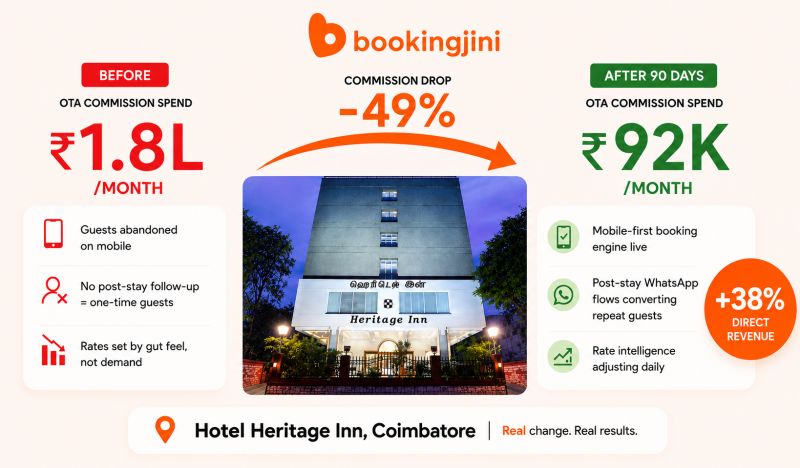
This is the story of Hotel Heritage Inn, Coimbatore, and how a few strategic changes helped reduce OTA commission spend by 49% while increasing direct revenue by 38% in just 90 days.
The Challenge: High Occupancy, Low Profitability
Like many independent hotels, Hotel Heritage Inn was attracting guests through major OTAs.
Occupancy wasn’t the issue.
Profitability was.
Every OTA booking came with a commission, eating into room revenue before the guest had even checked in.
When the team analyzed the booking journey, they discovered three common challenges that many hotels face.
1. Guests Were Abandoning Bookings on Mobile
More travelers now research and book hotels using their smartphones.
However, the hotel’s booking experience wasn’t designed with mobile users in mind.
The result?
Potential guests visited the website but dropped off before completing their reservations.
Every abandoned booking represented revenue that eventually flowed back to OTAs.
2. Every Guest Was Treated Like a One-Time Guest
After checkout, communication stopped.
No thank-you message.
No personalized offer.
No reminder to book directly for the next stay.
Guests who enjoyed their experience simply returned to the OTA the next time they planned a trip.
The hotel was repeatedly paying to acquire the same customer.
3. Room Rates Were Based on Instinct, Not Demand
Pricing decisions were reviewed periodically rather than continuously.
Rates were adjusted based on experience rather than real-time market conditions.
In today’s hospitality landscape, where demand can change overnight, static pricing often means missed revenue opportunities.
The Solution: Fix the System, Not the Rooms
Improving profitability didn’t require renovating rooms or adding new amenities.
It required improving how the hotel attracted, converted, and retained guests.
Over the next 90 days, three strategic changes transformed the hotel’s distribution strategy.
Step 1: Launch a Mobile-First Booking Experience
The first priority was making it easier for guests to book directly.
A mobile-optimized booking engine was implemented within the first week.
The booking journey became faster, simpler, and more intuitive across smartphones and tablets.
Instead of losing visitors during the booking process, the hotel began converting more website traffic into confirmed reservations.
Step 2: Introduce Daily Rate Intelligence
Rather than reviewing pricing occasionally, the hotel adopted a more dynamic approach.
Rates were adjusted based on changing market demand, competitor pricing, and booking trends.
This allowed the property to remain competitive without relying solely on discounting or OTA promotions.
Smarter pricing meant stronger revenue performance while maintaining healthier margins.
Step 3: Turn OTA Guests into Direct Guests
One of the biggest opportunities lay in guests who had already experienced the hotel.
Instead of letting those relationships end at checkout, the hotel introduced automated post-stay WhatsApp communication.
Guests received timely follow-up messages encouraging them to book directly for future stays.
The result was remarkable.
Around 14% of guests who initially booked through OTAs returned through direct channels.
Instead of paying commission again, the hotel retained more revenue while strengthening guest relationships.
The Results After 90 Days
The impact wasn’t immediate—it was cumulative.
Each improvement strengthened the next.
As more guests booked directly, OTA dependency gradually reduced.
Here’s what changed.
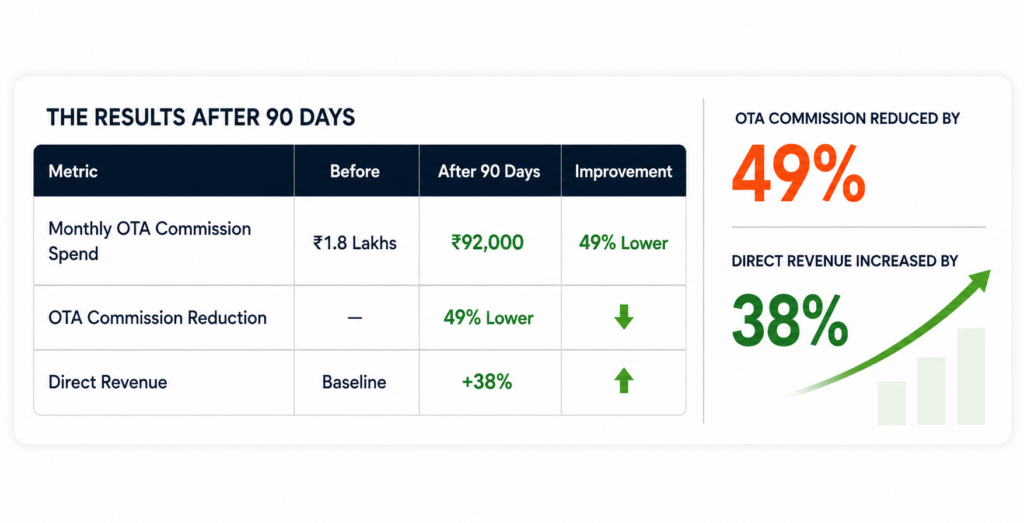
Reducing commission expenses wasn’t the only outcome.
The hotel also built a stronger foundation for long-term growth by increasing direct guest engagement and improving its booking ecosystem.
Why These Results Matter
Many hotels assume the only way to increase revenue is by increasing occupancy.
In reality, profitability often depends on where bookings come from, not just how many bookings you receive.
Every booking that shifts from an OTA to a direct channel improves net revenue.
It also creates new opportunities to:
- Build lasting guest relationships
- Collect first-party guest data
- Personalize future marketing
- Encourage repeat stays
- Reduce future acquisition costs
Small improvements in channel mix create significant financial impact over time.
Lessons for Independent Hotels
The experience of Hotel Heritage Inn highlights an important truth.
Hotels don’t need to eliminate OTAs.
OTAs remain powerful demand-generation partners and play an important role in attracting first-time guests.
The goal is to reduce dependency—not visibility.
A balanced distribution strategy means using OTAs to get discovered while building systems that encourage guests to return directly.
For many independent hotels, that balance can make the difference between growing revenue and growing profit.
Growth Doesn’t Always Require Bigger Investments
One of the most impressive aspects of this transformation is that nothing about the physical property changed.
The rooms remained the same.
The location remained the same.
The service remained the same.
What changed was the strategy behind guest acquisition and retention.
By focusing on technology, pricing intelligence, and guest communication, the hotel created a more efficient revenue engine—one that generated stronger results without increasing operating complexity.
The Takeaway
Every hotel owner asks the same question:
How do we increase profitability without relying even more on OTAs?
The answer isn’t abandoning distribution channels that already work.
It’s building a smarter system around them.
When your website converts visitors, your pricing adapts to demand, and your guests have a reason to return directly, every booking becomes more valuable.
Because the biggest gains don’t always come from selling more rooms.
They come from keeping more of the revenue each room already generates.
Key Takeaways
- OTA commissions are a necessary acquisition cost—but they shouldn’t become a permanent cost for repeat guests.
- A mobile-first booking experience reduces website booking abandonment.
- Dynamic pricing helps maximize revenue based on real-time demand.
- Post-stay guest engagement can successfully convert OTA guests into repeat direct customers.
- Improving your distribution strategy can significantly increase profitability without changing your property.
Ready to Reduce OTA Dependency?
If you’re wondering how much revenue your hotel could recover by increasing direct bookings, the first step is understanding your current distribution mix.
Whether your goal is to reduce commission costs, improve direct conversions, or build stronger guest relationships, small operational improvements can deliver measurable financial results over time.
The right strategy doesn’t replace OTAs—it complements them, helping your hotel grow more profitably while taking greater ownership of every guest relationship.
About Bookingjini
Bookingjini is India’s all-in-one hotel technology platform — Booking Engine, Channel Manager, PMS, CRM, CRS, Rate Shopper, AI Chatbot (Jini Assist), and AI Review Management — built for independent hotels under one modern, connected interface. Hotels on Bookingjini capture 30% of their total bookings directly from their website at zero commission.
Book a free demo at bookingjini.com – https://bookingjini.com/get-started/