
OTAs are exceptional at filling rooms. But if they become your primary distribution strategy, the real cost extends far beyond the commission you pay. It affects guest relationships, profitability, and long-term growth.
Imagine receiving a booking for one of your premium rooms.
The room rate is INR 5,000. The reservation comes through a leading Online Travel Agency (OTA), and your occupancy for the night looks healthy. At first glance, it feels like a successful sale.
But before your front desk welcomes the guest or housekeeping prepares the room, 18% of your revenue—INR 900—is already gone in commission.
Now multiply that by hundreds of bookings each month.
For many hotels, OTA commissions are accepted as the cost of doing business. But commission is only the visible expense. The bigger question is this:
What happens after that guest checks out?
If they return and book through the same OTA again, you’ll pay another commission to acquire a guest you’ve already hosted. The transaction ends, but the dependency continues.
This is why the conversation shouldn’t be about eliminating OTAs. It should be about creating a healthier balance between OTA bookings and direct bookings.
The Visible Cost: Every OTA Booking Has a Price
Let’s look at a simple example.
A guest books a room worth INR 5,000.
- Room Revenue: INR 5,000
- OTA Commission (18%): INR 900
- Revenue Received by Hotel: INR 4,100
At first glance, INR 900 may not seem significant. But over time, the numbers tell a different story.
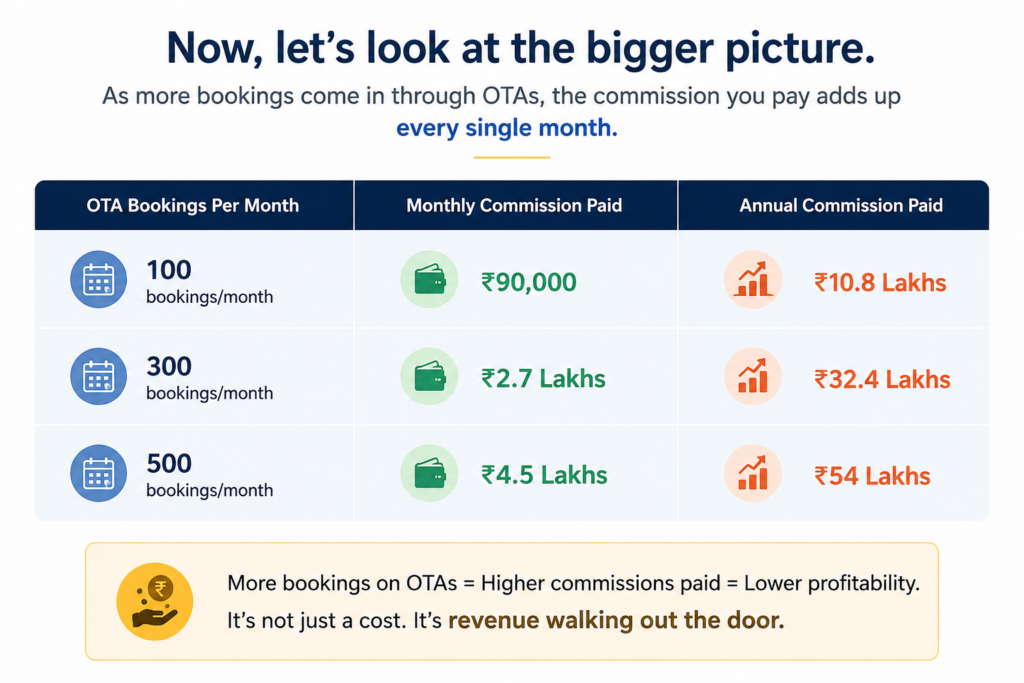
For many independent hotels, that’s enough to renovate rooms, upgrade technology, launch marketing campaigns, or invest in staff training.
The question isn’t whether OTAs deserve their commission—they absolutely do for the demand they generate.
The question is whether every repeat booking should continue costing the same.
The Hidden Cost Is Bigger Than the Commission
Most hotels focus on the INR 900 they lose today.
Few think about the revenue they lose tomorrow.
When guests book through an OTA, the platform owns much of the customer journey.
The OTA introduces the guest to your property.
The OTA facilitates the booking.
The OTA encourages future travel.
And when that guest starts planning another trip, guess where they usually begin their search?
Back on the OTA.
Instead of building a direct relationship with your guest, you’ve effectively rented one.
That’s the real cost of overdependence.
Guest Ownership Is the New Competitive Advantage
Today’s hospitality industry is increasingly driven by data and personalization.
Hotels that understand their guests can create better experiences, communicate more effectively, and encourage repeat stays.
Direct bookings allow hotels to build that relationship.
When guests book directly, hotels gain valuable first-party data such as:
- Booking preferences
- Travel patterns
- Stay history
- Special occasions
- Marketing consent
- Loyalty opportunities
This information helps hotels create personalized offers instead of generic discounts.
Over time, every direct booking becomes more valuable than the last.
OTAs Are Not the Enemy
Let’s be clear.
OTAs remain one of the most powerful distribution channels in hospitality.
They offer:
- Massive global visibility
- Marketing reach impossible for most independent hotels
- Mobile-first booking experiences
- International customer acquisition
- Demand during low-occupancy periods
- Instant credibility through reviews
Without OTAs, many hotels would struggle to reach entirely new audiences.
That’s why the smartest revenue managers don’t ask,
“How do we replace OTAs?”
Instead, they ask,
“How do we use OTAs strategically?”
Think of OTAs as Discovery Platforms
The healthiest distribution strategies follow a simple principle.
Acquire guests through OTAs. Retain guests through direct channels.
The first booking is about visibility.
The second booking is about relationships.
If a guest enjoyed staying at your hotel, there should be a compelling reason to return directly.
That could include:
- Best Rate Guarantee
- Exclusive website-only offers
- Complimentary breakfast
- Early check-in or late checkout
- Flexible cancellation
- Loyalty rewards
- Personalized promotions
The goal isn’t to compete with OTAs.
It’s to give guests a reason to book directly the next time.
Why a 10% Shift Can Transform Your Revenue
Hotels often assume they need dramatic changes to improve profitability.
In reality, even small improvements compound over time.
Let’s assume a hotel receives 300 bookings every month.
The average room rate is INR 5,000.
If just 30 bookings shift from OTA to direct channels:
30 × INR 900 commission = INR 27,000 saved every month.
Over one year:
INR 27,000 × 12 = INR 3.24 Lakhs saved.
And that’s only commission.
Now consider the additional benefits.
Those guests are easier to remarket.
They’re more likely to become repeat customers.
They’re easier to upsell with room upgrades, dining experiences, spa packages, or airport transfers.
Small shifts create long-term gains.
That’s the power of compounding in hotel distribution.
Five Practical Ways to Increase Direct Bookings
Improving your direct booking ratio doesn’t happen overnight. It happens through consistent improvements across your guest journey.
1. Invest in a High-Converting Booking Engine
Your website shouldn’t simply showcase your property—it should make booking effortless.
A fast, mobile-friendly booking engine with secure payments and minimal steps reduces booking abandonment.
2. Offer Value, Not Just Discounts
Competing purely on price isn’t sustainable.
Instead, offer benefits guests can’t get on OTAs.
Examples include:
- Complimentary breakfast
- Free room upgrades (subject to availability)
- Flexible cancellation
- Welcome amenities
- Loyalty points
Guests often value convenience and exclusivity more than small price differences.
3. Capture Guest Data Responsibly
Every stay is an opportunity to build a long-term relationship.
Collect guest preferences, email addresses, and consent for future communication.
A personalized email after checkout can be more effective than expensive acquisition campaigns.
4. Stay Connected After Checkout
Many hotels lose contact with guests after they leave.
Instead, continue the conversation.
Share seasonal offers.
Celebrate birthdays and anniversaries.
Invite them back with personalized promotions.
Repeat guests typically cost less to acquire and often spend more during their stay.
5. Measure Your Distribution Mix
Revenue isn’t just about occupancy.
It’s about where your bookings come from.
Track metrics such as:
- Direct Booking Ratio
- OTA Contribution
- Repeat Guest Percentage
- Customer Acquisition Cost
- Revenue Per Available Room (RevPAR)
- Net Revenue After Distribution Costs
The best-performing hotels monitor these numbers every month—not just at year-end.
The Future Belongs to Hotels That Own Their Guests
Hospitality is becoming more competitive every year.
New OTAs emerge.
Marketing costs continue to rise.
Customer expectations evolve.
Hotels that build direct relationships will always have a strategic advantage.
They’ll understand their guests better.
They’ll spend less acquiring repeat business.
And they’ll keep more of every booking.
It’s Not About Choosing Between OTAs and Direct Bookings
This isn’t an either-or decision.
OTAs and direct channels serve different purposes.
OTAs are exceptional demand generators.
Direct bookings are long-term profit generators.
Successful hotels don’t eliminate one for the other.
They create the right balance.
Use OTAs to introduce your hotel to new travelers.
Then create an experience—and a booking journey—that gives guests every reason to come back directly.
Because every percentage point you shift from OTA to direct isn’t just commission saved.
It’s a stronger guest relationship.
A healthier profit margin.
And a more sustainable hospitality business.
Key Takeaways
- OTA commissions are only the visible cost of distribution.
- The hidden cost is losing repeat guests to third-party platforms.
- OTAs should be used to acquire first-time guests, not every guest.
- Increasing your direct booking ratio by even 10% can significantly improve profitability over time.
- A balanced distribution strategy delivers both occupancy and long-term revenue growth.
Frequently Asked Questions
Are OTAs bad for hotels?
No. OTAs are valuable demand-generation partners that help hotels reach new audiences and maintain occupancy. The challenge arises when hotels become overly dependent on them for repeat business.
What is a healthy direct booking ratio?
The ideal mix varies by market and property type, but many successful hotels aim to steadily increase direct bookings while using OTAs strategically for guest acquisition and market visibility.
Why are direct bookings more profitable?
Direct bookings eliminate OTA commissions, provide access to guest data, enable personalized marketing, and increase opportunities for repeat stays and ancillary revenue.
About Bookingjini
Bookingjini is India’s all-in-one hotel technology platform — Booking Engine, Channel Manager, PMS, CRM, CRS, Rate Shopper, AI Chatbot (Jini Assist), and AI Review Management — built for independent hotels under one modern, connected interface. Hotels on Bookingjini capture 30% of their total bookings directly from their website at zero commission.
Book a free demo at bookingjini.com https://bookingjini.com/get-started/