The gap between hotels that consistently outperform their competitive set and those that don’t is rarely strategy. It is almost always data — what they have, how they use it, and how fast they act on it.
Every revenue management decision is made under uncertainty. The revenue manager does not know with certainty how many guests will book next Friday. Cannot predict exactly what a competitor will charge tomorrow. Cannot know whether an upcoming local event will drive demand to this hotel’s segment or bypass it entirely.
What separates consistently high-performing hotels is not the absence of uncertainty. It is the quality of information used to navigate it.
Internal data — what the hotel already has
The PMS is the richest source of historical RM intelligence: occupancy by date and room type, ADR by segment and channel, booking lead times, cancellation rates, length-of-stay patterns, guest repeat frequency. The critical caveat: PMS data is only as clean as the data entry discipline that created it. Hotels with inconsistent segment coding, manual rate overrides without documentation, or sloppy cancellation handling will find their PMS data unusable for meaningful analysis.
The Channel Manager provides real-time data on how inventory is distributed and consumed across every connected OTA and direct channel. Which channels are converting? What is the lead time on OTA bookings versus direct? Are rate parity rules adhered to?
The Booking Engine should provide conversion data — not just booking confirmations, but visitor behaviour. How many website visitors searched availability? What percentage converted? Which rate types convert best? This is the intelligence that reveals how effectively the hotel’s website is performing as a revenue channel.
External data — what the market is telling the hotel
Competitor rate data from a Rate Shopper is the single most underutilised tool in Indian independent hotel RM. Without knowing where the hotel is positioned relative to its competitive set in real time, every pricing decision is made without market context. A ?4,200 rate is neither high nor low — it is only meaningful relative to what similar hotels at the same destination are charging right now.
Forward demand signals include local event calendars, public holiday patterns, flight data, and macro travel trends. A hotel in Jaipur that knows about an upcoming conference or festival weeks in advance can adjust its pricing proactively — rather than discovering the demand spike three days before arrival when inventory is already partially committed.
The three highest-priority data investments for any independent hotel
- Connected PMS and Channel Manager— sharing data in real time eliminates the most dangerous gap: inventory decisions made without a live picture of what is actually available and committed
- Rate Shopper running daily competitor monitoring— provides the market context without which no pricing decision is fully informed
- Integrated Booking Engine feeding conversion data back— closes the direct channel intelligence gap that most hotels are currently operating without
About Bookingjini
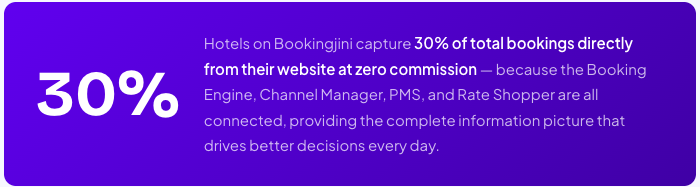
Bookingjini is India’s all-in-one hotel technology platform — Booking Engine, Channel Manager, PMS, CRM, CRS, Rate Shopper, AI Chatbot (Jini Assist), and AI Review Management — built for independent hotels under one modern, connected interface. Hotels on Bookingjini capture 30% of their total bookings directly from their website at zero commission.
Book a free demo at bookingjini.com ?
Next in the series — Week 8 ? Revenue Management Analysis: Data into Decisions